Learning Continuous Neural Representations Enables Scalable and High-Fidelity Electron Microscopy
Abstract
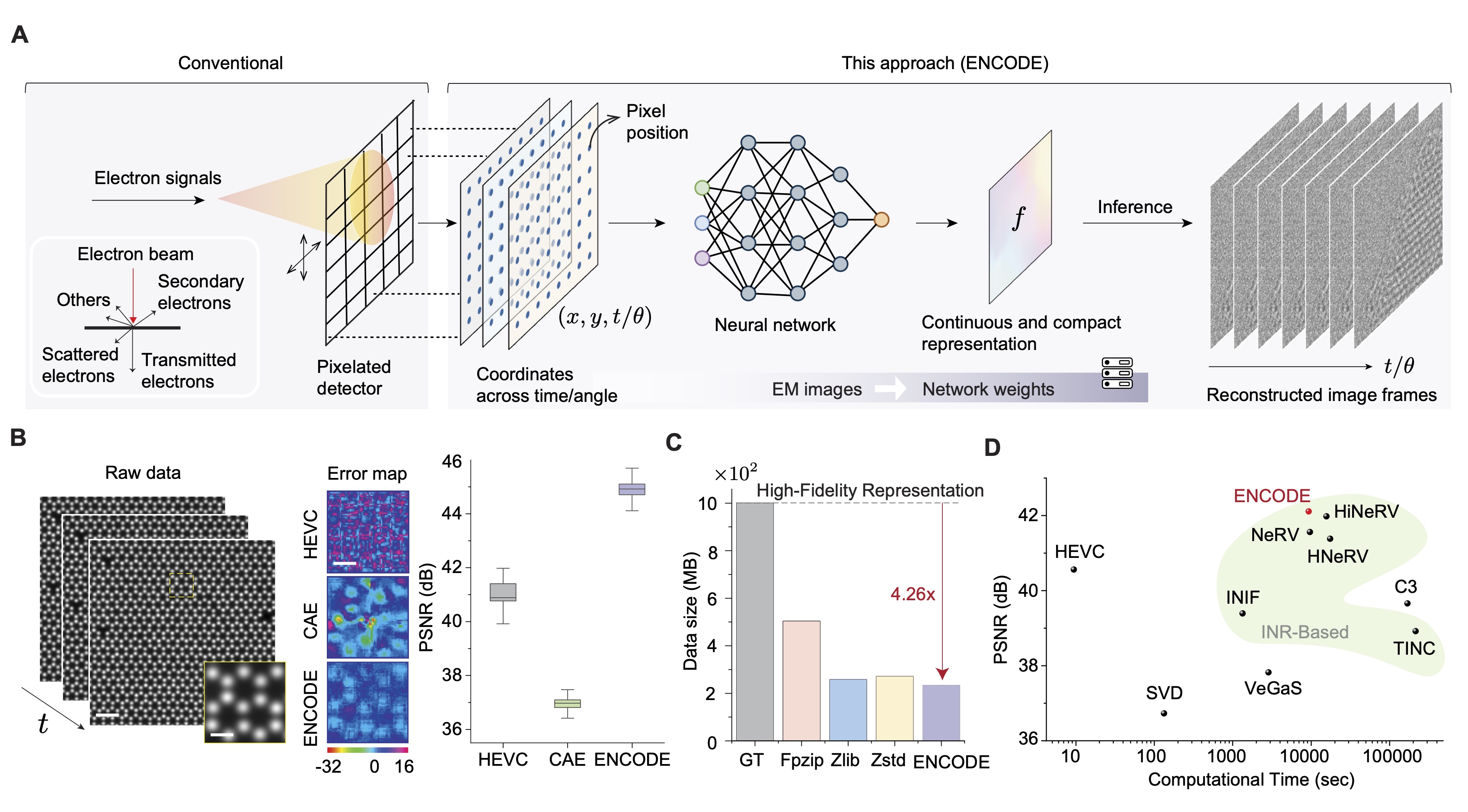
Electron microscopy (EM) has become an indispensable tool for investigating the nanoscale structure of diverse materials across physical and life sciences. However, the conventional frame-based data representation, which relies on detector pixel arrays, artificially discretizes the underlying continuous signals. This results in inherently redundant, noise-sensitive data, constrained by hardware limits, that obscures the specimen’s intrinsic properties.
To overcome these fundamental inefficiencies, we introduce a framework that learns a continuous representation directly from raw data, encoding it as neural network weights rather than as discrete pixel arrays. The resulting representation is intrinsically compact, achieving significant data compression while preserving quantitative fidelity. It also enables continuous signal querying, temporal interpolation, and robust denoising under challenging conditions. We validate this approach through comprehensive benchmarking across four major EM modalities and demonstrate its scientific utility by recovering transient atomic dynamics in V-doped WS₂, revealing a vacancy-driven self-repair pathway that is invisible in conventional acquisition. This work provides a scalable pathway for efficient high-fidelity storage, enhanced accessibility, and robust inference of physical dynamics from undersampled measurements in EM.
Code
The implementation is available at: github.com/TISGroup/ENCODE.
Reference
Li, L., Zhu, F., Yan, Z. et al. Learning Continuous Neural Representations Enables Scalable and High-Fidelity Electron Microscopy. Cell Reports Physical Science 7(9), 103540 (2026). DOI: 10.1016/j.xcrp.2026.103540.